
Christmas Day Is Half-Time: How PC Game Demand Moves Through Black Friday and the Holidays
Close to 40% of a year’s PC game units sell in Q41, and about a third of the whole year’s units move from Black Friday onward2. It’s no surprise that November planning tends to revolve around one date.
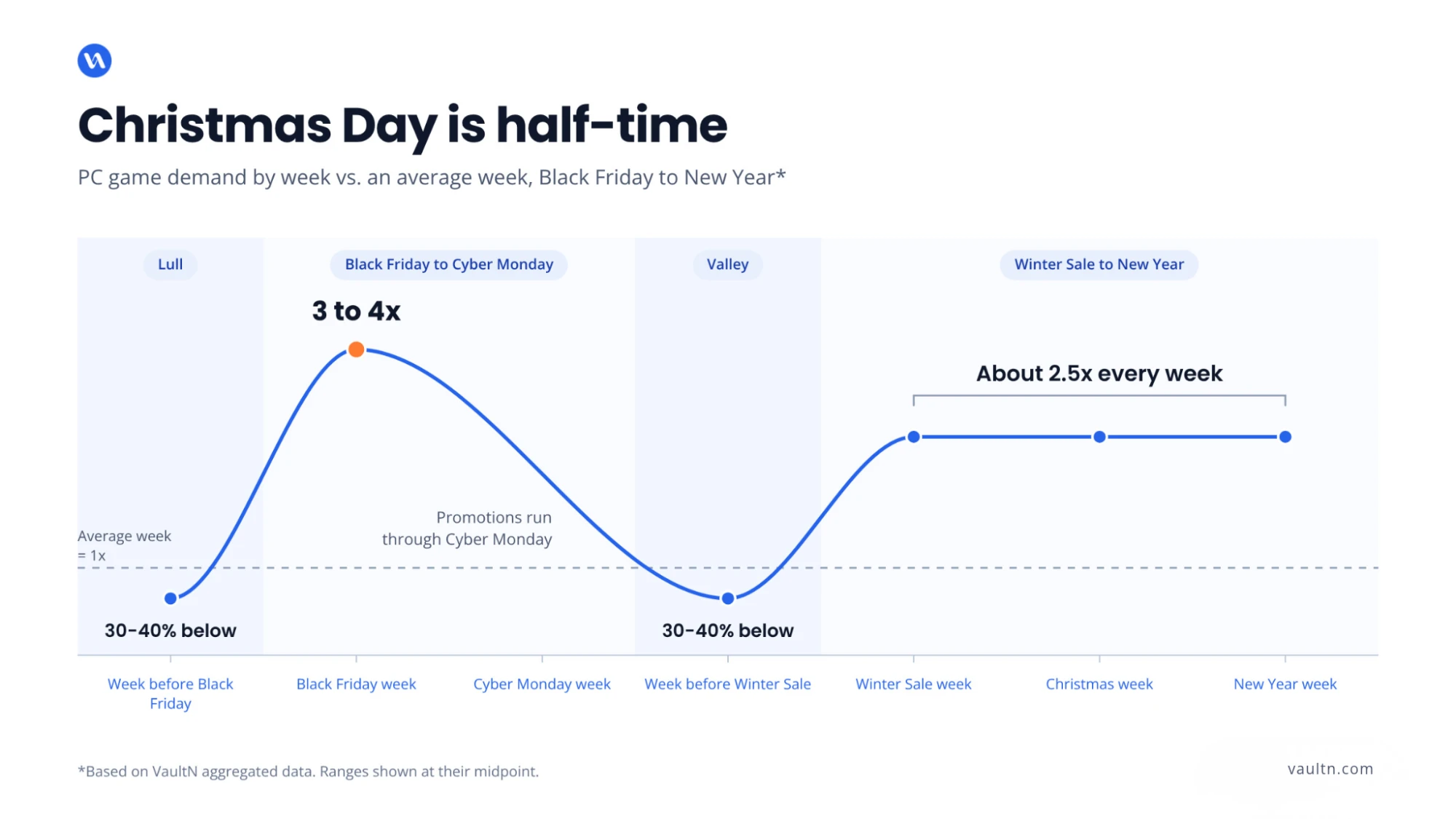
But Black Friday is one peak in a longer season, and it behaves differently from the rest. Across VaultN’s network, the window from late November to early January moves in four phases: a lull, the Black Friday peak, a short valley, and a second, broader peak that runs from the Steam Winter Sale into the new year1. As Julian Migura, VaultN’s co-founder and COO, puts it: “Christmas Day is not the finish line, it’s the half-time line”2.
Here’s what each phase looks like, and what it means for publishers planning the season.
The four phases of the season
1. The lull. The week before Black Friday runs 30 to 40% below an average week1. Shoppers know the discounts are coming, and they wait.
2. Black Friday week. In 2025, Black Friday week delivered 15% of Q4 units and ran at 3 to 4x an average week1. The lift reaches almost every sales channel: six out of seven channels on the network at least double their revenue that week2.
3. The valley. Black Friday doesn’t end on the Friday. Cyber Monday promotions run into December 1, and in Europe sales held at 1.4x a normal week even after Black Friday. Germany ran at almost 2x into early December, carried by local gifting dates like Sinterklaas on December 5 and Nikolaus on December 62. The real dip comes a week later. Between Cyber Monday and the Winter Sale, the network drops 30 to 40% below an average week1.
4. Christmas to New Year. From the Winter Sale through New Year’s week, each week runs at about 2.5x an average week1. It’s a smaller multiple than Black Friday, but it lasts three weeks and covers far more of the catalog.
Black Friday lifts what you promote
Black Friday week is the biggest single week of Q4, but the lift is concentrated. About 85% of Black Friday units on our network came from publishers’ deep discounts on back catalog, and the rest of the network was flat that week1.
So the first decision is which titles to promote. Titles that aren’t promoted shouldn’t be forecast to lift.
The second decision is how deep to go, and back catalog and newer titles need different answers. For a back-catalog title, a deep cut is often what brings it back into view. For a newer title, the risk lasts longer. Players follow prices through wishlists and price trackers, and as Julian says, “if that price tracker records your historic low, it’s a permanent recording”2. A very deep cut resets the price players will wait for next time.
Timing also matters more than most plans assume. On average across the network, the Black Friday revenue peak lands on the Tuesday before Black Friday, not on the day itself. Sales that run 7 to 10 days tend to perform best2. For 2026, that means opening promotions on Monday, November 23, and keeping them live through Cyber Monday into December 1.
Finally, stagger discounts across channels instead of setting one new low everywhere on November 27. It protects the price floor and gives each channel its own moment.
The holidays run past December 25
The second peak is broader because it’s driven by time and gift money, and both arrive late. In Julian’s words, it “arrives essentially after December 24th, 25th, depending on how you celebrate.” In revenue terms, New Year’s week can match or even exceed Christmas week2.
Public data shows the same. Alinea Analytics estimates that ARC Raiders sold 250K Steam copies on Boxing Day 2025 alone, and 1.2M copies between December 21, 2025 and January 4, 20266.
Gifting continues into January, too. Spain gifts on Three Kings Day on January 6, Orthodox Christmas falls on January 7, and in Japan the holiday window runs past the first week of January. A holiday sale that ends on December 31 misses part of the season.
The gifting gap
This year there’s a new factor. In June 2026, Valve announced it is ending the Steam Gift Card program at retail stores and expects stock to run out by the end of the year. Existing cards still redeem, and Steam Digital Gift Cards continue4.
The physical cards mattered at the holidays. Valve reported that players redeemed more than $80 million in physical wallet cards between December 20 and 31, 20233. Gift cards also lead holiday shopping intent: InComm Payments’ 2025 Holiday Report found that 68% of US consumers planned to buy gift cards, ahead of clothing and toys5.
The challenge is that, as Julian points out, “the gifters are not gamers”2. They don’t know the platforms or how regions work, and they won’t set up an account to buy a present. That demand doesn’t disappear. It moves to digital codes and wallet top-ups sold through the sales channels where gift buyers already shop, and publishers who are present there will capture it.
Plan the dips, not only the peaks
The calendar has shifted too. Steam’s autumn sale moved to October, so there’s no storewide Steam event around Black Friday this year2, and other sales channels become the main route for Black Friday promotions on PC keys. If you do run a Steam discount around Black Friday, Valve’s usual discount cooldown applies, because Black Friday offers aren’t exempt the way seasonal sales are7. Valve does surface discounted titles on a Black Friday Special Offers page, but it isn’t a storewide sale.
The dips are worth planning as carefully as the peaks. The lull before Black Friday is quiet in Western markets, but it isn’t quiet everywhere. Diwali, Singles’ Day in China and Buen Fin in Mexico all fall in early to mid November, and they’re worth having on the calendar for publishers selling in those regions. The valley before the Winter Sale is a good moment to step back from discounting and prepare for the second peak, while markets with early-December gifting keep buying.
How the season flows
Put together, the next seven weeks look like this:
- Mid-November is the lull. Most players are waiting for Black Friday, and it’s the last calm week to settle prices, decide which titles promote and make sure key inventory is in place across sales channels.
- Black Friday week starts earlier than the date suggests, with the revenue peak on Tuesday and promotions running through Cyber Monday into December 1.
- Early December stays active in gifting markets. The network-wide dip comes in the second week of December, just before the Winter Sale.
- The Steam Winter Sale opens on December 178 and starts the second peak. As the last shipping days pass, gift buyers turn to digital codes.
- Christmas and New Year run as one long stretch of gifting, gift card redemption and wishlist purchases. Keeping promotions and stock live until at least January 4, and longer for markets that gift in January, covers the second half of the season.
Looking ahead
Julian expects more holiday revenue to happen outside Steam in the years ahead, and January to be treated as a peak in its own right2. Publishers who plan for the whole season, from the lull before Black Friday to the first week of January, will be ready for both.
Julian goes deeper on holiday pricing, gifting and global sales on the Naavik Gaming Podcast.
VaultN aggregated data, based on observations across partners on the VaultN network.
Julian Migura, co-founder and COO of VaultN, on the Naavik Gaming Podcast, "The Black Friday Playbook: How Game Publishers Can Maximize Holiday Sales," November 10, 2026. Naavik
Valve, Steam Annual Summary 2023, February 19, 2024 (physical wallet card redemptions). Game Developer
Valve, Steam Wallet FAQ, updated June 9, 2026.
InComm Payments, 2025 Holiday Report, October 6, 2025.
Alinea Analytics, The Steam games that sold the most copies over the holidays, January 2026.
Valve, Steam News, July 2025.
GameSpot, "When is the next Steam sale," Steam Winter Sale 2026 dates. GameSpot